Voice & speech
Cluttering
Specialist assessment and therapy for cluttering across the lifespan - for clearer, easier communication.
Understanding cluttering
What is Cluttering?
Cluttering is a fluency disorder in which speech is perceived as too fast, too irregular, or both - often described as sounding “jerky”, “mumbled” or “out of sync”. Under the widely used LCD (Lowest Common Denominator) definition proposed by St. Louis & Schulte (2011), cluttering involves a rate that is perceived as too rapid, too irregular, or both, together with excessive normal dysfluencies (fillers, revisions, phrase repetitions), atypical pauses, and/or reduced syllable and word clarity - such as telescoped words (“probly” for “probably”) or slurred sound sequences.
Cluttering can occur on its own or alongside stammering, ADHD, autism, or learning differences. It is less well-known than stammering, but it is not rare - estimates suggest around 1–2% of people show clutter-like speech, with many never formally identified. The good news is that speech and language therapy can make a real difference: with awareness, targeted rate and clarity work, and self-monitoring strategies, most people who clutter can be understood easily and speak with far less effort and repetition.
Your experience
What you might be experiencing
People who clutter often describe the feeling of their thoughts running ahead of their mouth. Words can pile up, sentences restart mid-flow, and important sounds or syllables get lost - leaving listeners saying “sorry, what?” more often than feels fair. Others might say your speech is too fast, mumbled or hard to follow, even though from the inside it feels like you are speaking perfectly normally. That mismatch between how you sound and how you feel is one of the hallmarks of cluttering and often the reason it takes years to be identified.
You may notice it most in longer sentences, when explaining something complicated, when you're excited or tired, or in conversations with people who aren't yet used to your speech. Some people find it affects meetings, presentations, phone calls or teaching; others notice frustration in close relationships, or a growing habit of keeping answers short to avoid being asked to repeat. If any of this feels familiar, please know that cluttering is a recognised, treatable fluency difference - not carelessness, not lack of thinking, and definitely not something you have to keep working around alone.
The evidence
How speech therapy helps
Evidence-based cluttering therapy - grounded in the work of Kenneth O. St. Louis, David Ward and Yvonne van Zaalen - combines awareness training, targeted rate control, and clarity / articulation work, alongside strategies for pausing, phrasing and self-monitoring. Building awareness is critical: research consistently shows that people who clutter often under-perceive their own rate and clarity, so any effective therapy starts by developing a reliable inner ear (van Zaalen & Reichel, 2015).
Reviews of cluttering intervention (Scaler Scott et al., 2014; van Zaalen et al., 2011) report meaningful improvements in intelligibility, listener ratings and communication confidence when therapy is individualised and includes practice in real-life contexts. For people whose cluttering co-occurs with stammering, ADHD or autism, therapy is adjusted accordingly - combining fluency techniques with executive function and pragmatic support as needed.
1–2%
estimated prevalence of cluttering in the general population
St. Louis & Schulte, 2011
Most
clients show measurable gains in intelligibility with individualised therapy
Scaler Scott et al., 2014
~1/3
of people who clutter also stammer - combined therapy is often helpful
van Zaalen et al., 2011
Awareness
building self-monitoring is the strongest predictor of long-term change
van Zaalen & Reichel, 2015
Finding your rhythm
Treatment structure
Cluttering therapy is like tuning a metronome - first we notice the tempo, then we adjust it, and finally we anchor it into everyday speech. Each stage builds on the one before.
STEP 01
Tune in
Listening
Build a reliable inner ear - recording, listening back, and learning to hear your own rate and clarity accurately.
STEP 02
Set the tempo
Slow & steady
Practise phrasing, pausing and gentle rate control - not slower speech, but more organised speech.
STEP 03
Sharpen the beat
Clarity
Targeted articulation and syllable work so every sound lands - especially at speed and in longer sentences.
STEP 04
Keep the rhythm
Everyday use
Carry gains into meetings, teaching, phone calls and social life, with self-monitoring strategies you can rely on.
Your appointment
What sessions look like with Claire
Sessions are one-to-one, 45–60 minutes, and often involve short audio or video recordings - so we can listen back together and build shared, honest awareness of your speech. From there we work on tempo, phrasing, pausing and clarity through targeted exercises and real conversation tasks - the kinds of talking that matter in your day.
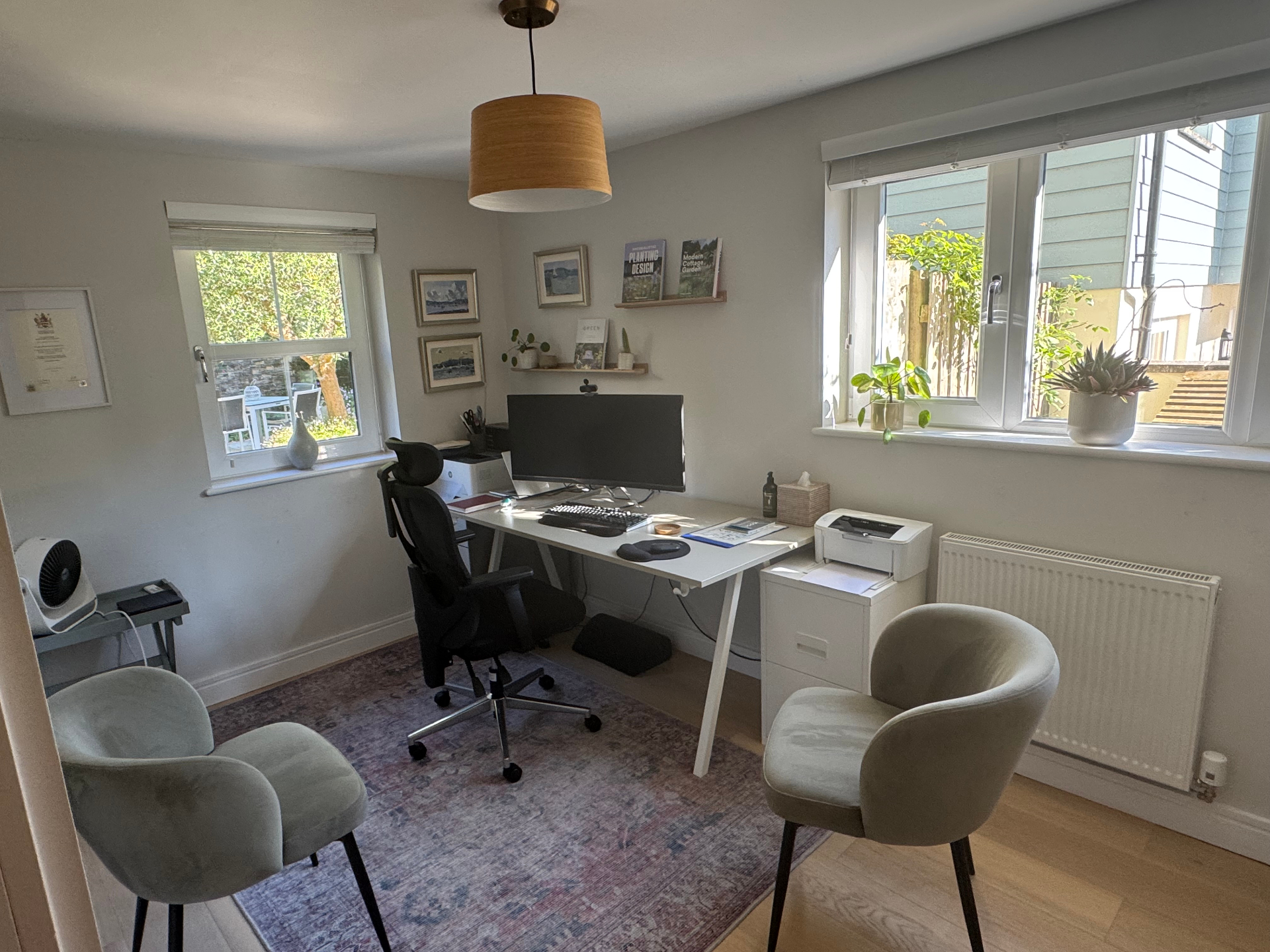
Where cluttering overlaps with stammering, ADHD or autism, therapy is shaped around all of these things - never treating a diagnosis in isolation. Sessions are calm, unhurried and completely collaborative, and can take place at Claire's home office in Falmouth or online.
Continuing your progress
What happens after the programme?
By the end of a block of therapy, most clients report speech that is easier to follow, fewer requests to repeat themselves, and - often for the first time - a genuine internal sense of their own rate and clarity. That inner ear is what keeps working long after therapy ends.
You will leave with a small set of self-monitoring strategies and short daily practice ideas that fit into real life. Some clients return for occasional review sessions - before a presentation, at the start of a new job, or if speech starts to speed up again during a stressful period. Claire will always signpost to trusted resources such as the International Cluttering Association and STAMMA's cluttering pages.
Voices from clients
Feedback from sessions
“Claire worked with my daughter over a number of sessions to smooth out her speech. She was warm, reassuring and patient and together they explored a range of techniques for her to practice and draw on when necessary.”
C.O.
“We started to see an improvement after a couple of sessions – and towards the end others started commenting on how his speech had improved. Claire was friendly, flexible and professional throughout.”
Parent
Further reading
Additional Information
Where else to find information
The International Cluttering Association and STAMMA both host clear, up-to-date information about cluttering, personal stories and resources for professionals and families.
Cluttering alongside other differences
Cluttering often overlaps with stammering, ADHD, autism, or learning differences. Claire's approach is neurodivergence-affirming and joined up - the aim is clearer, easier communication, not a change to who you are.
Interested in cluttering therapy?
Get in touch to arrange an initial assessment - no referral needed, and no assumption that a diagnosis is already in place.
Frequently asked questions