Neurological care
Dementia & Primary Progressive Aphasia
Personalised communication support for people living with dementia and PPA - and for the families and carers alongside them.
Understanding the diagnosis
What is Dementia & Primary Progressive Aphasia?
Dementia is an umbrella term for a group of progressive conditions - most commonly Alzheimer's disease, vascular dementia, dementia with Lewy bodies and frontotemporal dementia - that affect thinking, memory, language, judgement and everyday communication. In the UK, around 982,000 people are currently living with dementia, a number projected to rise to over 1.4 million by 2040 (Alzheimer's Society, 2024).
Primary Progressive Aphasia (PPA) is a rarer form of dementia in which language is the earliest and most prominent difficulty. It has three main variants - semantic, non-fluent/agrammatic, and logopenic - and it typically affects people in their 50s, 60s and early 70s. People with PPA often keep insight, personality and everyday skills for a long time, while words, sentences and understanding gradually become harder. Speech and language therapy is one of the few interventions with a strong evidence base for both dementia and PPA, focusing on maintaining communication, protecting relationships and planning ahead.
Your experience
What you might be noticing
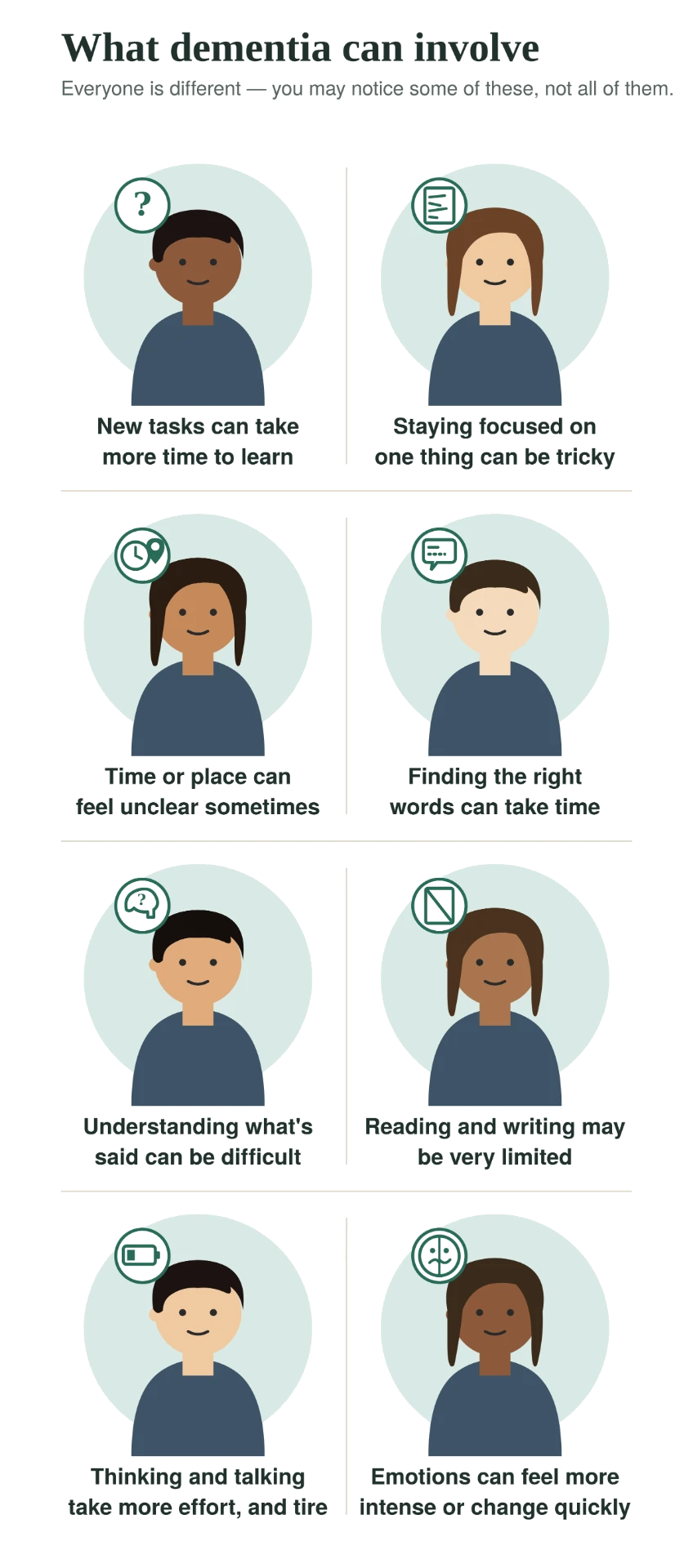
You may find that specific words no longer come to mind, that sentences take a longer route to arrive, or that names of familiar people and objects have started to slip. Some people notice their reading or writing changing before their speech; others find conversations in noisy rooms, on the phone, or with several people at once have become suddenly exhausting. Family members often notice repeated questions, stories retold in the same words, or a growing quietness in situations that were once easy.
Alongside the language changes, there is usually a great deal of emotional weight - worry about the future, frustration in the moment, and a sense of shrinking as conversations become harder to hold on to. For partners, adult children and carers, it can be difficult to know how to help without taking over. Speech and language therapy offers a calm, structured space to understand what is happening, to build practical tools that keep communication flowing, and to plan ahead while there is still time to shape the plan together.
The sheet alongside illustrates some of the ways dementia can affect everyday communication and wellbeing.
The evidence
How speech therapy helps
Speech and language therapy for dementia and PPA is one of the most researched non-drug interventions in this field. NICE guidance (NG97) explicitly recommends SLT input for people whose communication or swallowing is affected by dementia. For PPA, the Better Conversations with PPA programme (Volkmer et al., UCL, 2020–2023) has shown that structured communication partner training reduces barriers to conversation and improves confidence for both the person with PPA and their family members.
Therapy works on several levels at once: preserving the words, phrases and topics that matter most to you; teaching practical strategies for the moments when language breaks down; supporting the people around you to become skilled communication partners; and, where helpful, introducing personal communication books, life-story tools and low-tech AAC. Cochrane and systematic reviews (e.g. Cadório et al., 2017; Volkmer et al., 2020) consistently report improvements in communication confidence, conversation participation and family wellbeing following targeted SLT.
982k
people living with dementia in the UK today
Alzheimer's Society, 2024
~40%
of people with dementia will experience significant language changes
Banovic et al., 2018
Strong
evidence for communication partner training in PPA
Volkmer et al., 2020
50–70s
typical age of onset for Primary Progressive Aphasia
Rare Dementia Support, UCL
Your pathway
Treatment structure
A gentle bridge across the changes ahead - six connected stepping stones that hold the person, the family and the future together.
STAGE 01
Meet
A gentle first conversation - no pressure, no jargon. We start with what matters most to you.
STAGE 02
Understand
A careful language and communication assessment, sensitive to how you are on the day.
STAGE 03
Preserve
Targeted work on the words, names, phrases and topics that are most important to your daily life.
STAGE 04
Connect
Communication partner training so the people around you become confident, skilled conversation allies.
STAGE 05
Anchor
Personal communication books, life-story tools and low-tech AAC to hold on to identity and choice.
STAGE 06
Plan ahead
Gentle future-planning: advance communication wishes, review points, and support for the road ahead.
Your appointment
What sessions look like with Claire
Sessions are slow-paced, quiet and human. Claire takes time to understand not just the language changes, but the person - favourite topics, family names, routines, the words that carry the most weight. Where helpful, partners, adult children or paid carers are warmly included, because most meaningful change happens in real conversations at home, not in the therapy room.
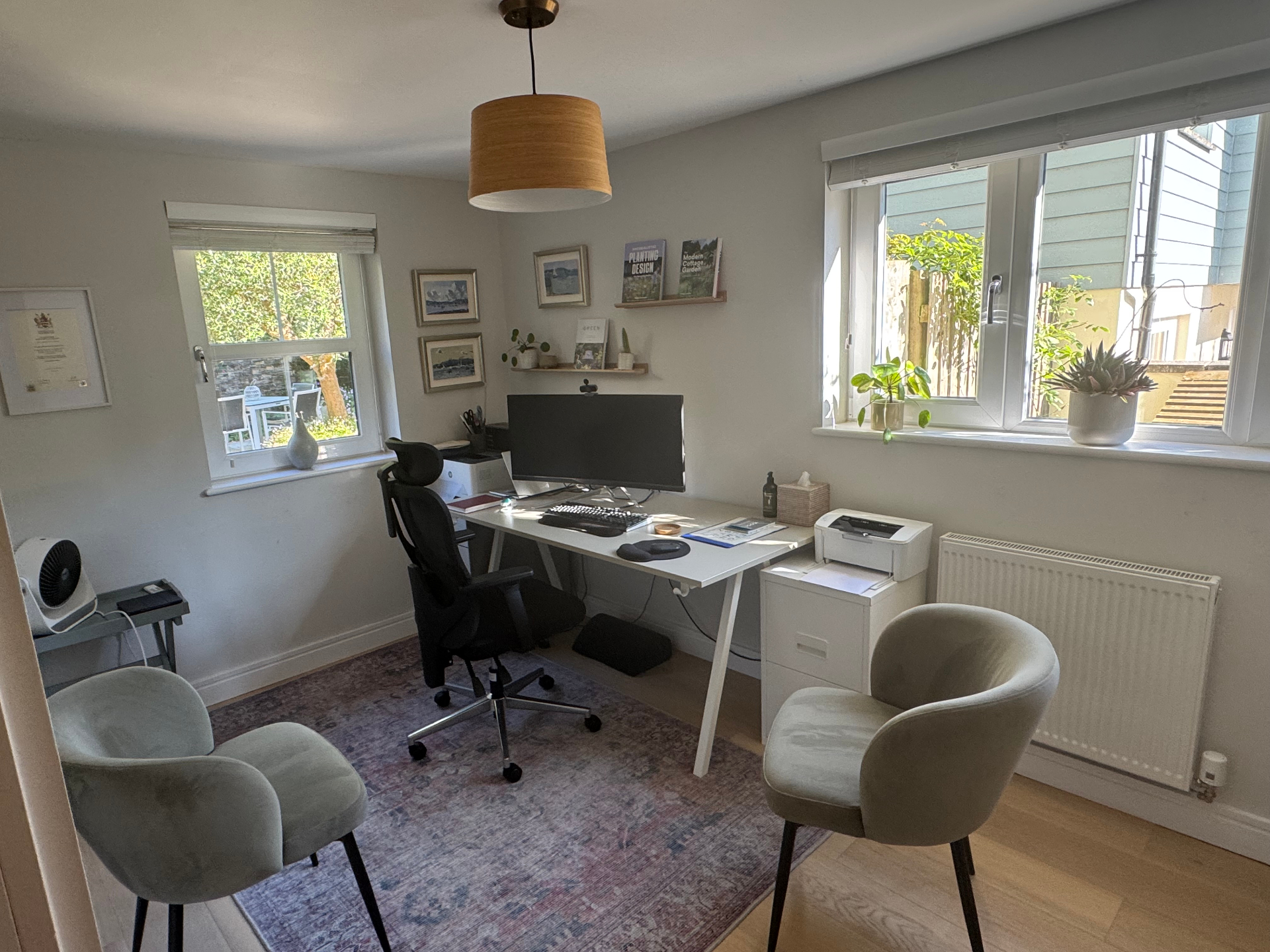
Appointments can take place in Claire's Cornwall home office, in your own home, or online via Zoom or Microsoft Teams - whichever is least tiring on the day. Sessions typically last 45–60 minutes and are flexible around energy, appointments, and how you are feeling that week.
Continuing your progress
What happens after the programme?
Because dementia and PPA are progressive conditions, therapy is rarely a single one-off block. Many families find it most helpful to complete an initial block of 6–10 sessions, followed by planned review points - every few months, at a life change (a house move, a new carer, a wedding), or when communication has shifted noticeably. Between sessions, you will have a personalised communication plan, life-story materials, and practical strategies that partners and carers can use every day.
Where useful, Claire will liaise closely with your GP, memory clinic, occupational therapist, admiral nurse or care team, so the wider picture is joined up. The goal is always the same: to protect connection, choice and voice for as long as possible, and to walk gently alongside families as the picture changes.
Voices from clients
Feedback from sessions
“Claire has been brilliant for my brother. She is extremely professional, skilled, and knowledgeable. She is also flexible and adaptable and has tailored my brother's treatment to his needs but also to his personality. Claire is imaginative and has great empathy. I unreservedly recommend her - I am sure she would find a way to help anyone with speech problems.”
J.C.
“Very quickly, I realised what a huge difference Claire was already making in my life. She has always given me a safe haven to not be scared of trying, and our sessions are often full of emotion and laughter. She shows me that I can learn, grow and thrive.”
Client L.L.
Support beyond therapy
Organisations we often point families towards
Therapy is only one part of the picture. These are the organisations we recommend most often to the people and families we work with - for information, peer support, specialist nursing and practical help for carers.
Dyscover
A specialist charity for people living with long-term aphasia and their families, offering group therapy, conversation support and genuine community.
Rare Dementia Support
UCL-led specialist support groups for rarer dementias, including dedicated Primary Progressive Aphasia groups for people living with PPA and their families.
Dementia UK - Admiral Nurses
Home of Admiral Nurses, specialist dementia nurses who give families continuity, expert advice and a free helpline throughout the dementia journey.
Alzheimer's Society
Clear, trustworthy information on every type of dementia, local support services, Dementia Connect advisers and an active online community.
Young Dementia Network
Information and connection for people diagnosed with dementia under 65 - including work, family and financial questions that older-age services rarely cover.
Carers UK
Practical guidance on carer's allowance, respite, employment rights and looking after your own wellbeing while caring for someone else.
Further reading
Additional Information
Where else to find information
Alzheimer's Society, Dementia UK and Rare Dementia Support (UCL) offer trusted, evidence-based information on dementia and Primary Progressive Aphasia, including specific PPA support groups for people and families.
Working with your wider team
Claire regularly works alongside GPs, memory clinics, neurologists, Admiral Nurses, occupational therapists and case managers, so your care is joined up and your family are never navigating the picture alone.
Discuss joined-up supportConsidering support for dementia or PPA?
Get in touch to arrange a gentle initial conversation - for yourself, for a family member, or on behalf of someone you care for.
Frequently asked questions