Voice & speech
Neurodivergence-Affirming Communication Support
Strengths-based, respectful communication work that honours how you naturally think, connect and communicate.
Our approach
What is Neurodivergence-Affirming Communication Support?
Neurodivergence-affirming communication support is speech and language therapy that starts from a simple, non-negotiable premise: autistic, ADHD, dyslexic and other neurodivergent communication styles are different, not deficient. Rather than trying to make neurodivergent people communicate like neurotypical people, this approach works alongside you to build skills, strategies and environments that support your natural way of thinking, connecting and communicating - while helping you thrive in a world that is often not built with you in mind.
This model reflects the current international shift in the field, informed by autistic-led research, the double empathy problem (Milton, 2012), and updated guidance from the Royal College of Speech and Language Therapists and the American Speech-Language-Hearing Association. It explicitly rejects compliance-based therapies and practices such as masking training, forced eye contact, or “quiet hands”. Support is collaborative, consent-based, and led by your goals - not a checklist of neurotypical norms.
Your experience
What you might be experiencing
You might be an autistic or ADHD adult who has spent decades masking - mirroring neurotypical conversation patterns, monitoring your face and tone, censoring info-dumps, and arriving home exhausted from the effort of “seeming fine”. You might be a late-identified adult trying to make sense of years of misinterpretation, or a young person struggling to find your voice in a classroom that keeps asking you to communicate in ways that feel unnatural. Perhaps conversations feel like trying to speak two languages at once, or you notice recurring miscommunications with partners, colleagues or family that don't seem to happen with other neurodivergent people.
You may also be a parent seeking support for your neurodivergent child, or a professional wanting coaching for the specific communication demands of work - meetings, feedback, disclosure, difficult conversations. Whatever brings you here, this work starts from the assumption that your communication style is valid, that masking has costs (unmasking is often a goal in itself), and that meaningful change happens when we build strategies with your brain, not against it.
The evidence
How speech therapy helps
Affirming, strengths-based communication support is grounded in the neurodiversity paradigm and supported by a growing evidence base. Research consistently shows that miscommunication between autistic and non-autistic people is a two-way problem - not a deficit in autistic people - a finding often called the “double empathy problem” (Milton, 2012; Crompton et al., 2020, in Autism). Autistic people communicate more effectively with other autistic people than with non-autistic partners, which reframes intervention away from “fixing” the neurodivergent person.
Systematic evidence also shows that masking is associated with significant costs, including higher rates of burnout, anxiety, depression and suicidality in autistic adults (Cassidy et al., 2018; Hull et al., 2021, Autism in Adulthood). Neurodivergence-affirming work supports self-understanding, sustainable communication strategies, informed choice about masking, and access to accommodations - with a strong focus on wellbeing and identity, not behavioural conformity.
1 in 30
adults in the UK are estimated to be autistic; many identified later in life
O'Nions et al., Lancet Regional Health, 2023
Higher
communication success between autistic peers vs. mixed pairs
Crompton et al., Autism, 2020
Masking
linked with burnout, anxiety and suicidality in autistic adults
Cassidy et al., 2018
Affirming
practice is now the RCSLT-recommended approach for autistic adults & children
RCSLT clinical guidance, 2021
A non-linear pathway
Treatment structure
Neurodivergent brains rarely work in tidy straight lines - and neither does this work. Sessions move between five interconnected areas depending on what's most alive for you that week.
Your goals
Consent-led,
strengths-based
Self-understanding
Making sense of your own communication style, sensory profile and processing needs.
Environmental fit
Adjusting environments - work, school, home - so you can communicate at your best.
Practical strategies
Tools for meetings, disclosure, feedback, small talk and difficult conversations - used as you choose.
Unmasking & wellbeing
Space to explore masking, energy costs, identity and safe unmasking, at your pace.
Advocacy & systems
Support with reasonable adjustments, disclosure, and communicating with services and workplaces.
We move fluidly between these areas - never in a fixed order.
Your appointment
What sessions look like with Claire
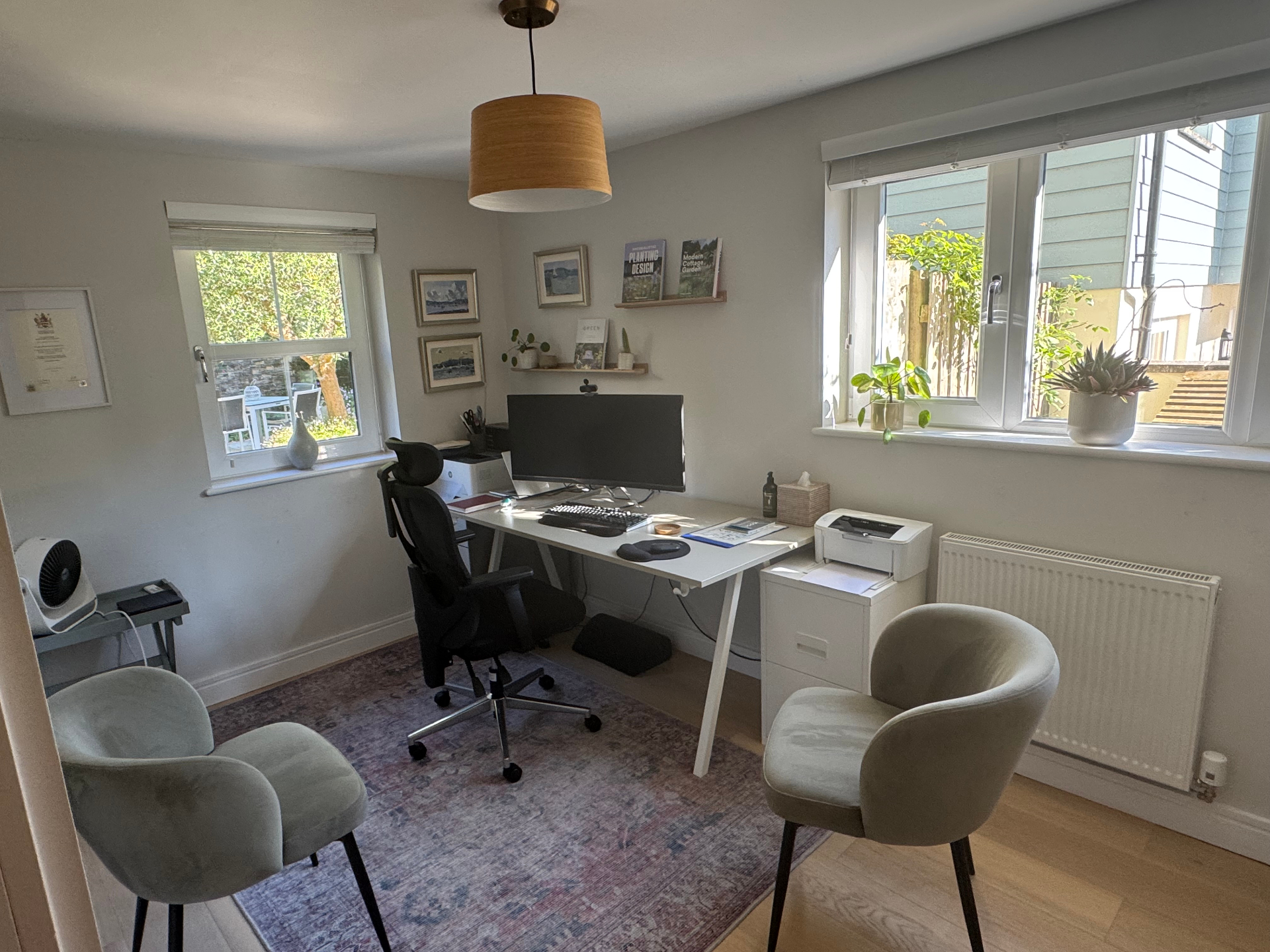
Sessions take place in a calm, sensory-aware home office - or online, which many clients prefer for reduced sensory load. Lighting is soft, breaks are welcome, stimming is welcome, cameras can be off, scripts and written prep are welcome, and there is absolutely no expectation of eye contact, small talk, or performing neurotypical warmth. Sessions are one-to-one, typically 45–60 minutes, and completely led by what you want to work on.
We often use written pre-agendas so you know what's coming, communicate by email between sessions, and use direct, unambiguous language throughout. Nothing is done to you - everything is collaborative, consent-based, and adjusted as we go.
Continuing your progress
What happens after the programme?
Many clients leave with a much clearer, more compassionate picture of their own communication - what serves them, what drains them, what they want to keep, and what they want to stop performing. For some, that leads to concrete changes at work or in relationships; for others, the biggest change is internal: less shame, less second-guessing, more trust in their own way of communicating.
You'll finish with a personalised communication profile, a set of strategies that suit your brain, and a clear plan for the settings that matter most. Claire is happy to link with employers, schools, GPs and diagnostic services where useful, and always signposts to autistic-led and ADHD-led communities such as Autistica, Ambitious about Autism and ADHD UK.
Voices from clients
Feedback from sessions
“She is also flexible and adaptable and has tailored my brother's treatment to his needs but also to his personality. Claire is imaginative and has great empathy.”
J.C.
“Claire is also highly adaptable, tailoring her approach to the individual rather than applying a one-size-fits-all model. She brings professionalism, compassion and creativity to every aspect of her work.”
Emily Denny
Further reading
Additional Information
Where else to find information
Autistica, the National Autistic Society and RCSLT all publish neurodivergence-affirming guidance and resources for autistic and ADHD adults, young people and families.
Work & school adjustments
Claire can support you or your child in identifying and requesting reasonable adjustments at work, in education, or with services - with letters, meetings and joined-up MDT working where appropriate.
Interested in affirming communication support?
Get in touch - no diagnosis or referral needed, and no expectation of a particular way of communicating in the initial conversation.
Frequently asked questions