For children aged 8+
Paediatric Stammering Therapy
Supportive, individualised therapy for children and young people aged 8 and over who stammer.
Please note: stammering is the only difficulty for which Claire sees children, and she works with children from age 8 upwards.
Understanding stammering
What is Paediatric Stammering?
Stammering (also known as stuttering) is a neurodevelopmental difference in the way speech is produced. A child who stammers may repeat sounds, syllables or whole words (“c-c-can I go?”), stretch sounds out (“ssssometimes”), or get stuck with no sound coming out at all - sometimes accompanied by physical tension, blinking, or avoidance of certain words. It typically emerges between the ages of two and five, affecting around 8% of pre-school children, with roughly 1% continuing to stammer into adulthood. Stammering is not caused by anxiety, poor parenting, or a child's intelligence - the current evidence points to differences in the brain networks that coordinate speech, often with a genetic component.
While the outward signs are what most people notice, stammering is often described as an iceberg: the visible moments of dysfluency sit above the surface, and underneath sit the feelings a child may develop about talking - frustration, embarrassment, or a growing reluctance to speak up in class, on the phone, or with new people. Early, sensitive support makes a real difference. Evidence-based speech and language therapy - combining parent-led work with younger children and confidence-focused therapy with older children - can reduce the frequency and impact of stammering, help children communicate freely, and protect the wonderful, chatty voice underneath.
Your experience
What you might be experiencing
Every child who stammers is different, but families often describe a similar pattern. You may have noticed your child repeating the first sound or syllable of a word, stretching sounds out, or pausing mid-sentence as if a word has become momentarily stuck. Some children push through with visible effort - a tightening of the jaw, a blink, or a small physical struggle - while others go quiet, swap words for easier ones, or give up on what they wanted to say. These moments can come and go in waves: strong one week, barely there the next, then louder again after a growth spurt, a new school term, or an exciting day. That variability is completely normal, but it can leave parents feeling unsure about whether to say something, when to wait, and where to turn for advice.
Alongside the speech itself, you may be noticing changes in how your child feels about talking. A once-chatty toddler might start saying “I can't say it” or “you tell them”. An older child may become reluctant to read aloud, answer the register, order in a café, or speak on the phone. Some children show frustration or upset in the moment; others hide it well and only mention it at bedtime. Parents often carry their own worries too - wondering if they are helping or making things harder, whether to finish a sentence, correct a word, or simply wait. If any of this feels familiar, you are not alone, and none of it is your fault. Stammering is a difference in how the brain coordinates speech, not a reflection of your parenting or your child's ability. With warm, timely support, children can learn to communicate freely, feel proud of their voice, and know that what they have to say matters.
The Evidence
How speech therapy helps
Speech and language therapy is the recommended first-line approach for children who stammer, and the earlier support begins, the better the outcomes tend to be. For pre-school children, parent-delivered, play-based therapy has the strongest evidence base in the field. Randomised controlled trial evidence published in the British Medical Journal (Jones et al., 2005) found that children receiving early parent-led stammering therapy showed significantly greater reductions in stammering than a no-treatment control group at nine months, with many reaching near-zero levels of stammered speech.
For older children and young people, interaction-based and confidence-focused approaches draw on cognitive, behavioural and interaction-based techniques to reduce the impact of stammering on daily life. Alongside improvements in fluency, research consistently shows gains in communication confidence, willingness to speak up at school, and reduced anxiety around talking - helping children stay connected to friendships, learning, and the things they love.
8%
of pre-school children experience stammering at some point
Yairi & Ambrose, 2013
2.3×
more likely to reach near-zero stammering after early parent-led therapy
Jones et al., BMJ RCT, 2005
Any age
therapy is effective for pre-schoolers, school-age children and teenagers alike - it is never too late to start
RCSLT clinical guidelines
75%+
of children show meaningful gains in fluency & confidence after therapy
Millard et al., interaction therapy outcome studies
A clear pathway
Treatment structure
Every child's journey is unique, but our work together follows a gentle, considered structure - so families always know what to expect, and progress is reviewed at every stage.
STEP 01
Initial conversation
A relaxed, no-pressure chat with parents to understand your child's story, your worries, and what you're hoping for.
STEP 02
Assessment & formulation
Play-based, child-friendly assessment across speech, language and emotional wellbeing - shared back in plain, honest language.
STEP 03
Personalised therapy
Evidence-based therapy - parent-led, interaction-based, confidence-focused, or a blend - shaped around your child's age, temperament and everyday life.
STEP 04
Review & ongoing support
Regular reviews, home strategies, and school liaison - so gains carry into the classroom, playground and family life.
Your appointment
What sessions look like with Claire
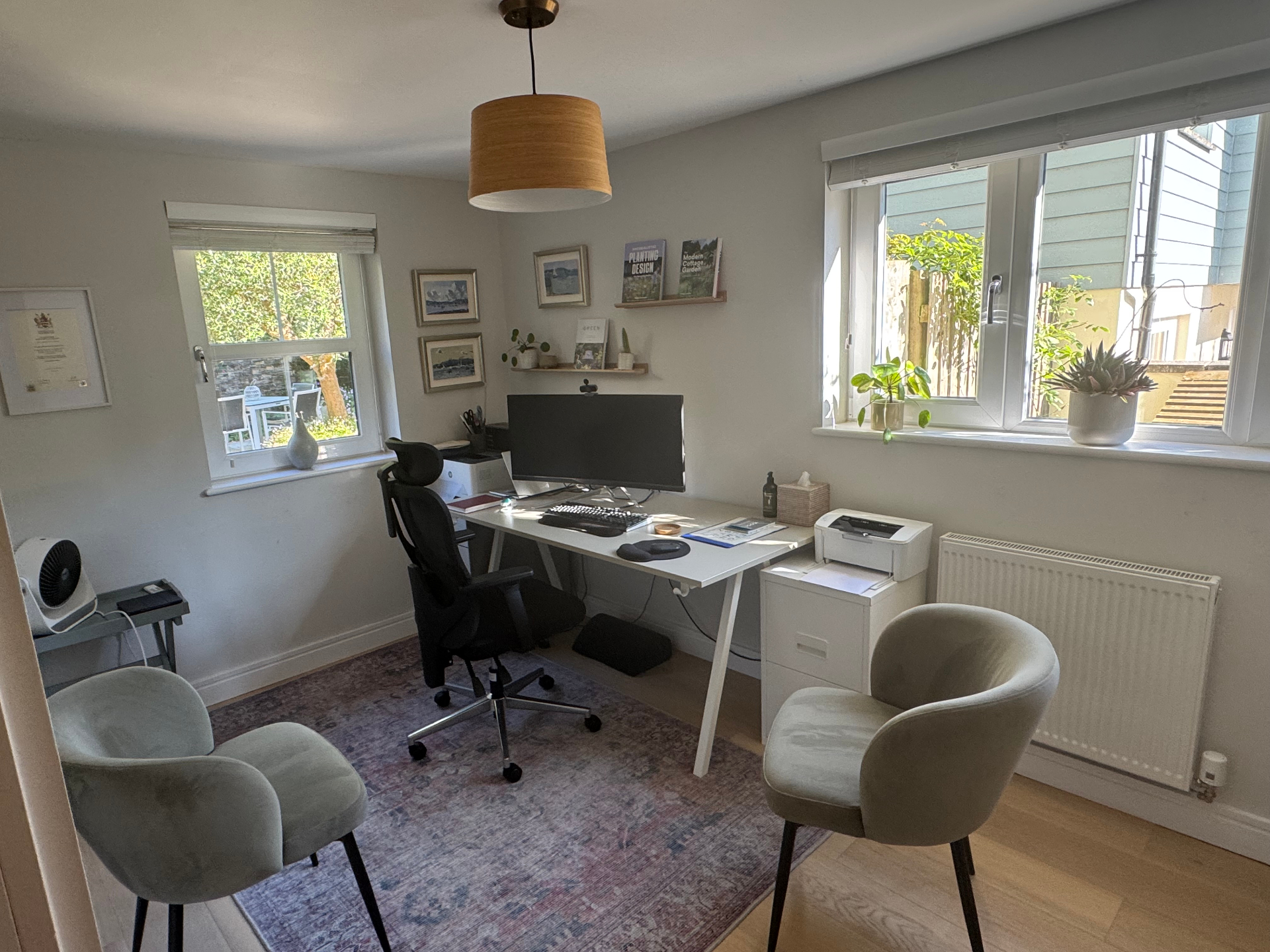
Each session takes place in a quiet, comfortable home office with space for your child to play, explore and practise using their voice. Sessions are warm, relaxed and built around your child's age and interests - younger children might spend time playing games, reading books and practising words through play, while older children and teenagers may work on confidence, presentation skills and strategies for tricky speaking situations. Parents and carers are involved throughout, especially with younger children, so you feel confident supporting your child at home.
Between activities we pause to talk about what your child is noticing, celebrate their efforts and adjust our approach as we go. You will see toys, games, visual feedback tools and a calm, unhurried pace that puts your child at the centre of the work. Sessions are one-to-one, typically last around 45 minutes to an hour, and are designed to feel supportive, engaging and practical - leaving your child with clear, achievable ideas to try between visits.
Continuing your progress
What happens after the programme?
By the end of a block of therapy, many families notice that stammering moments are happening less often, feeling less tense, or bothering their child less when they do occur. You may hear your child speaking up more at home, joining in at school, or tackling words and situations they previously avoided. Parents often say that the biggest change is not just in the speech itself, but in their child's confidence - the way they re-tell a story, answer a question, or chat with a grandparent on the phone. These gains tend to build gradually and are reinforced by the everyday practice woven into each session.
Importantly, therapy does not end when the sessions finish. You will leave with a clear understanding of how to support your child's communication at home, practical strategies to keep their confidence growing, and ideas for managing tricky speaking moments as they arise. Many families choose to return for occasional check-ins or top-up sessions with Claire, especially around transitions such as starting a new school, moving up a year group, or preparing for exams. With the right support in place, children can continue to communicate freely, feel proud of their voice, and know that what they have to say matters - now and into the future.
Voices from families
Feedback from sessions
“Claire worked with my daughter over a number of sessions to smooth out her speech. She was warm, reassuring and patient and together they explored a range of techniques for her to practice and draw on when necessary. I would (and indeed have!) recommend her to anyone who is looking for help with their stammering.”
C.O.
“Claire has recently been working with my 11 year old son who had developed a stutter... She saw him once a week for 6 weeks... We started to see an improvement after a couple of sessions – and towards the end others started commenting on how his speech had improved. Claire was friendly, flexible and professional throughout, and immediately made my son feel very comfortable.”
Parent
Further reading
Additional Information
Where else to find information
STAMMA (the British Stammering Association) and the Royal College of Speech and Language Therapists offer trusted information about childhood stammering, early intervention, and support for families.
Support at school
Claire can liaise with teachers and SENCOs to help your child's setting understand how to support them confidently. Small changes - such as allowing extra time to answer, reducing pressure to perform, and celebrating participation - can make a big difference to a child who stammers.
Interested in starting paediatric stammering therapy?
Get in touch to discuss whether stammering therapy could be right for your child, and to arrange an initial assessment.
Frequently asked questions