Voice & speech
Voice Therapy
Personalised assessment and therapy for voice difficulties across work, home and everyday life.
Before we begin
ENT assessment
Before starting voice therapy, we ask that you have had an Ear, Nose and Throat (ENT) assessment of your larynx within the last six months. This usually involves a brief examination of the vocal folds by an ENT consultant or a specialist voice clinic, most often using a small camera (laryngoscopy or stroboscopy).
This matters for two reasons. First, safety: hoarseness and voice change can occasionally be a sign of something that needs medical rather than therapeutic attention, and only an ENT examination can rule that out. Second, effectiveness: knowing exactly what your vocal folds are doing - whether we are working with muscle tension, nodules, a polyp, vocal fold palsy or post-surgical change - allows therapy to be targeted precisely rather than generically.
You can be referred for an ENT assessment through your GP on the NHS, or arrange one privately. If you are unsure where to start, or you have had an assessment but are not certain whether it is recent enough, please do get in touch - Claire will happily talk it through with you and point you in the right direction.
Understanding voice
What is Voice Therapy?
The voice is produced when air from the lungs passes between two small folds of tissue in the larynx - the vocal folds - causing them to vibrate hundreds of times a second. When that finely tuned system is disrupted by inflammation, muscle tension, overuse, structural changes (such as nodules, polyps or cysts), neurological conditions, hormonal shifts or the after-effects of surgery, the voice can become hoarse, breathy, weak, strained, or unreliable. Voice difficulties (dysphonia) affect around 30% of adults at some point in their lives, and are especially common in teachers, singers, call-centre workers, health professionals and anyone whose job depends on speaking.
Voice therapy is the evidence-based first-line treatment for most functional and muscle-tension voice disorders, and a vital part of recovery after laryngeal surgery, radiotherapy or a period of vocal misuse. It combines a careful understanding of how your voice is being produced with practical exercises to release unnecessary tension, rebalance breath support, and rebuild efficient, resonant sound - so that speaking (and singing) feels easier, clearer and more sustainable throughout the day.
Your experience
What you might be experiencing
Voice problems can appear suddenly, after an infection or period of shouting, or creep in gradually over months and years. You may have noticed persistent hoarseness or a rough, gravelly quality to your voice, a voice that tires quickly through the day, a sensation of a lump or tightness in the throat, frequent throat clearing, or a voice that keeps “cutting out” on you at inconvenient moments. Some people describe a voice that feels weak or breathy, while others feel they are constantly straining or pushing to be heard - particularly in noisy classrooms, busy offices, meetings or over the phone.
Alongside the physical symptoms, voice difficulties can quietly reshape everyday life. You may find yourself avoiding phone calls, cancelling social plans, dropping out of choir, or worrying about the next day of teaching or presenting. It is easy to feel that something so ordinary being so hard is somehow your fault, but the truth is that voice problems are almost always a mechanical or physiological issue that responds well to the right support. With careful assessment and targeted therapy, most people find a voice that feels genuinely their own again - one that carries them through the day rather than one they are constantly nursing.
The evidence
How speech therapy helps
A Cochrane systematic review of voice therapy for adults with dysphonia (Ruotsalainen et al., 2007; updated by Desjardins et al., 2017) concluded that voice therapy is effective at improving voice quality and reducing symptoms compared with no treatment, and is recommended by ENT and voice specialists as the first-line intervention for most non-organic and many organic voice disorders. Approaches such as Vocal Function Exercises, Resonant Voice Therapy and Semi-Occluded Vocal Tract work (SOVT - straw phonation, humming, lip trills) have strong evidence for improving vocal efficiency, reducing strain and improving self-rated voice-related quality of life.
For teachers and other occupational voice users, systematic reviews (Hazlett et al., 2011) show that voice therapy reduces vocal symptoms, absenteeism and the risk of long-term voice damage. Following laryngeal surgery, early voice therapy is associated with better and more durable outcomes (Petrović-Lazić et al., 2015). Alongside measurable acoustic changes, most people notice a real shift in how they use their voice - less pushing, more ease, and a sense of finally getting their voice back.
30%
of adults experience a voice problem at some point in their lives
Roy et al., Laryngoscope, 2005
~80%
of people show significant improvement following voice therapy
Desjardins et al., 2017 review
6–12
sessions typical for most functional voice disorders
RCSLT voice guidance
3–4×
higher risk of voice problems in teachers vs the general population
Roy et al., 2004
Your voice journey
Treatment structure
A clear five-stage pathway that follows the arc of your voice - from quiet exploration through resonant, sustainable sound.
STAGE 01
Listen
A careful conversation and voice history - when it started, how it behaves, what matters most.
STAGE 02
Assess
Perceptual and acoustic assessment of your voice, in liaison with ENT where appropriate.
STAGE 03
Release
Gentle work to release laryngeal tension and rebalance breath support - the foundation for change.
STAGE 04
Rebuild
Targeted exercises (SOVT, resonant voice, vocal function) to build efficient, easy sound.
STAGE 05
Sustain
Carrying gains into work, singing and daily life - with a maintenance plan you can actually use.
Your appointment
What sessions look like with Claire
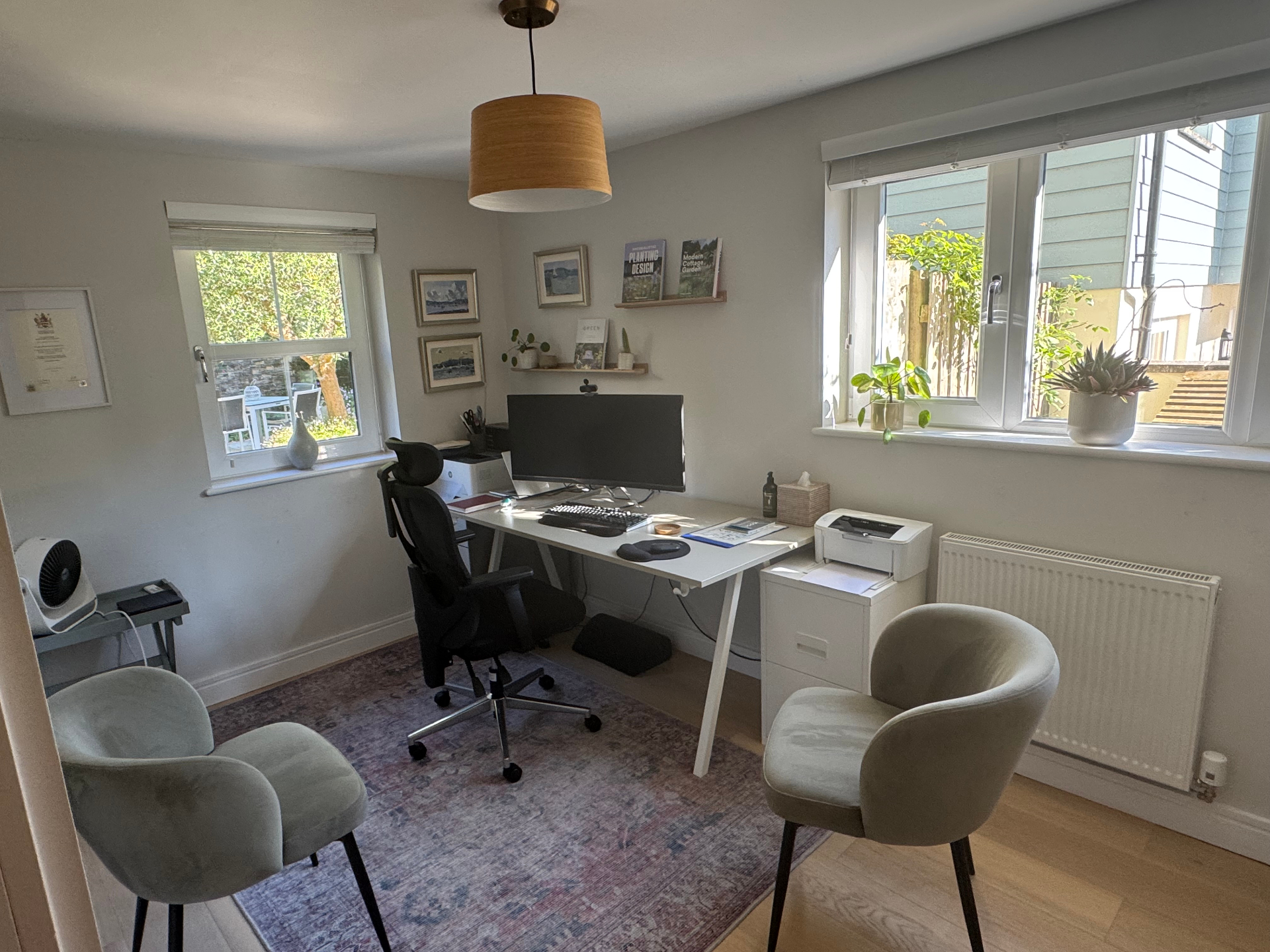
Voice sessions take place in a quiet, comfortable home office designed to help you tune into how your voice feels and sounds. We begin gently - noticing breath, posture and any patterns of holding - before moving into practical exercises tailored to your voice on the day. You will hear yourself, feel the difference, and leave each session with clear, portable strategies to practise in short bursts across the week.
Sessions typically last around 45 minutes to an hour and are one-to-one, so there is space to explore the situations that matter most to you - teaching a class, delivering a presentation, singing a particular passage, or simply getting through a long working day without losing your voice. Online sessions via Zoom or Microsoft Teams are equally effective for most voice work and can be a convenient way to fit therapy around a busy schedule.
Continuing your progress
What happens after the programme?
By the end of a block of voice therapy, most people notice a voice that feels easier to produce, lasts longer through the day, and no longer dominates their thinking. You will leave with a personalised “voice toolkit” - a short daily warm-up, a small number of targeted exercises, and a clear understanding of the vocal habits that help or hinder you. This is the piece that turns short-term improvement into a durable change.
Many clients choose to return for occasional check-ins - before a demanding term, at the start of a new performance run, or when life circumstances change. Where ongoing ENT input is needed, Claire will liaise with your consultant, GP or singing teacher to make sure everyone is working towards the same goals.
Voices from clients
Feedback from sessions
“I could not speak after having an extremely bad time with laryngitis and my vocal chords had been damaged. Claire was a life saver. Not only was she extremely welcoming and very positive, Claire made me feel that there was light at the end of the tunnel. The exercises and re training of my vocal chords was amazing, and after only a short time, I was able to use my voice again.”
J.S.
“I can not state enough how Claire helped me regain my confidence and hope, with the ability of speech again. I would recommend Claire to anyone who needs any kind of help within her professional capacity.”
J.S.
Further reading
Additional Information
Where else to find information
The British Voice Association and Royal College of Speech and Language Therapists both offer trusted, evidence-based information on voice care, dysphonia and voice therapy for professional voice users.
Working with your ENT team
Voice therapy works best alongside a laryngeal examination (typically nasendoscopy) with an ENT or laryngologist. Claire will liaise closely with your consultant or GP where useful, so recommendations are joined up and safe.
Discuss ENT liaisonInterested in starting voice therapy?
Get in touch to discuss whether voice therapy could be right for you, and to arrange an initial assessment.
Frequently asked questions